Weblog
The Complete History of Machine-Made Carpets, the Machines that Weave Them, and the Art of Modern Carpet-Making

The Complete History of Machine-Made Carpets, the Machines that Weave Them, and the Art of Modern Carpet-Making
Few objects in human history carry the weight of meaning that a carpet does. For more than two and a half thousand years, woven floor coverings have decorated palaces, anchored homes, defined identities, and told the stories of the cultures that produced them. The modern machine-made carpet is the latest and most refined chapter in that long story, marrying centuries of design tradition with the precision of contemporary engineering. At Molavi Carpet, we live at this intersection every day, weaving on the world’s most advanced Van de Wiele looms with 100% acrylic heat-set yarn while remaining faithful to the artistic heritage of Iran. This article is our complete guide to where machine-made carpets came from, who builds the machines that make them, the materials and methods involved, and the many forms they take today.
The Ancient Origins of Carpet Weaving
To understand the machine-made carpet, one must first appreciate the millennia of handcraft that preceded it. The oldest surviving knotted carpet, the Pazyryk rug, was discovered in a Scythian burial mound in Siberia and is dated to approximately the fifth century BCE. Its remarkable preservation in permafrost and the sophistication of its knotting reveal that carpet weaving was already a mature art form more than two thousand five hundred years ago. The Pazyryk’s symmetrical knots, refined border designs, and use of motifs strikingly similar to those of later Persian production strongly suggest origins in the Achaemenid Persian Empire or the cultures of Central Asia.
From these ancient beginnings, carpet weaving spread and flourished. Persia, in particular, became the spiritual home of the knotted carpet, with cities such as Tabriz, Kashan, Isfahan, Kerman, Qom, Mashhad, and Nain developing distinct regional styles over centuries. Each city refined its own palette, motif vocabulary, and knot type, transforming the carpet from a practical floor covering into a portable masterpiece of fine art. Beyond Persia, the looms of Anatolia, the Caucasus, Central Asia, India, China, and North Africa each produced their own celebrated traditions, ranging from the geometric clarity of Turkmen guls to the elegant medallions of Safavid court carpets.
For thousands of years, every single carpet in the world was produced the same way: by human hands, one knot at a time. A skilled weaver could tie a few thousand knots in a day, and a fine handmade carpet of moderate size might require six months, a year, or even several years to complete. Carpets were therefore objects of enormous value, often given as diplomatic gifts, accumulated as dowries, and recorded in royal inventories. The world’s demand for them, however, vastly outstripped what hand-weaving could supply, and this imbalance would eventually become the seed of an industrial revolution in textiles.
The Industrial Revolution and the Birth of the Machine-Made Carpet
The story of the machine-made carpet begins in the great workshops and mills of eighteenth and nineteenth century Europe, when the Industrial Revolution was transforming nearly every craft into a mechanised industry. Textiles were among the very first sectors to be mechanised, and within textiles, carpets followed close behind plainer fabrics. Two forces drove this transformation: the rapid growth of an urban middle class with new spending power, and an explosion of technical creativity in the design of looms.
The earliest mechanised carpets were produced in England, Belgium, and France during the eighteenth century. The town of Kidderminster became famous for its flat-woven ingrain carpets in the late 1700s, while Wilton, also in England, gave its name to a cut-pile weaving technique that would later define an entire category of premium carpet. Brussels carpet, with its uncut loop pile, became another European specialty, exported in large quantities throughout the nineteenth century. These early industrial carpets still required significant human input, but they marked the moment at which the carpet ceased to be exclusively a handmade object.
The decisive turning point came with the application of steam power and, soon after, the punched-card mechanism developed in France. By the middle of the nineteenth century, carpets could be woven mechanically with intricate multi-colour patterns at speeds no human weaver could match. The age of the machine-made carpet had truly begun.
The Pioneers Who Mechanised the Loom
Several individuals deserve to be remembered for transforming the carpet industry. Each contributed an innovation that, when combined with the others, made the modern machine-made carpet possible.
Edmund Cartwright and the Power Loom
In the 1780s, the English clergyman and inventor Edmund Cartwright designed one of the first practical power looms, demonstrating that weaving could be driven by mechanical force rather than human muscle. Though his earliest looms were intended for plain cloth, the principle he established, that a loom could be powered by water or steam, would shortly be applied to the more complex challenge of carpet weaving.
Joseph Marie Jacquard and the Punched Card
In 1804, the French silk weaver Joseph Marie Jacquard introduced an attachment that allowed a loom to read patterns from a chain of punched cards. The Jacquard mechanism made it possible to weave fabrics of unlimited design complexity automatically, without the need for a drawboy to manipulate threads by hand. This was a watershed moment. Without the Jacquard system, the elaborate floral and medallion patterns we now associate with quality machine-made carpets would simply not exist. The same principle of programmable pattern control, refined and digitised, still governs every modern computer-controlled carpet loom in the world today.
Erastus Bigelow and the Power-Driven Carpet Loom
In the United States, Erastus Bigelow took up the challenge of mechanising carpet weaving itself. In 1839 he patented a power loom for ingrain carpets, and over the following decade he developed power looms for Brussels and Wilton carpets as well. Bigelow’s achievement was extraordinary: he showed the world that the most complex pile carpets could be woven by machine, at a fraction of the time and cost of hand production. His mills in Massachusetts became models for the industry and his patents shaped carpet manufacturing for generations.
Halcyon Skinner and the Axminster Loom
The Axminster carpet, first hand-knotted in the English town of the same name in the eighteenth century, was thought to be too complex ever to be mechanised. Halcyon Skinner, working in the United States with the support of carpet manufacturer Alexander Smith, proved otherwise. In the 1850s and 1860s he developed a power-driven Axminster loom capable of producing carpets with very large numbers of distinct colours, perfectly suited to the elaborate patterns favoured in Victorian interiors. Skinner’s invention opened the door to mass-produced carpets that rivalled handmade rugs in design complexity.
The Twentieth Century: Synthetics, Tufting, and Mass Production
If the nineteenth century mechanised weaving, the twentieth century industrialised it on a global scale. Three developments stand out as transformative.
The Rise of Synthetic Fibres
For most of carpet history, the only available pile materials were wool, cotton, silk, and a handful of plant fibres. The twentieth century introduced a parade of synthetic alternatives: nylon, first commercialised in the late 1930s, brought unprecedented abrasion resistance and durability. Polypropylene, developed in the 1950s, offered moisture resistance, vivid colour, and low cost. Polyester delivered softness and stain resistance. Acrylic, introduced commercially in the 1950s by DuPont under the trade name Orlon, was specifically engineered to mimic the warm, soft hand of natural wool, and would later become the fibre of choice for premium machine-made Persian carpets, including the carpets we produce at Molavi. Each new fibre opened new design and performance possibilities, and the modern carpet industry would be unthinkable without them.
The Tufting Revolution
In the 1930s and 1940s, manufacturers in the southern United States, particularly around Dalton, Georgia and Chattanooga, Tennessee, adapted the simple craft of tufted bedspreads into a high-speed industrial process for producing carpets. Tufting machines, which insert pile yarns into a pre-woven backing using rows of needles, made wall-to-wall broadloom carpet affordable for ordinary households for the first time. By the 1960s, tufted carpet had transformed domestic interiors across the western world, and tufting remains the dominant method of mass-production carpet manufacture today, accounting for the overwhelming majority of broadloom carpet produced globally.
Computerisation and the Modern Jacquard
In the second half of the twentieth century, the original punched-card Jacquard system was replaced by electronic and ultimately fully digital pattern control. Designers could now create carpets in computer-aided design software and transmit the file directly to the loom. The number of colours, the resolution of patterns, and the speed of design iteration all increased dramatically. The age of the digital carpet had arrived.
The Van de Wiele Revolution
No discussion of the modern machine-made carpet is complete without Michel Van de Wiele NV, the Belgian manufacturer that has set the global standard for advanced carpet weaving for decades. Van de Wiele did not invent face-to-face Wilton weaving on its own, but the company refined, expanded, and digitised the technique to such an extent that its machines have become synonymous with high-end woven carpet across the world.
Face-to-Face Wilton Weaving Explained
In a face-to-face Wilton loom, two layers of fabric are woven simultaneously, one above the other, with pile yarns passing back and forth between them. A sword-shaped knife then slices through the pile threads in the middle, separating the two layers into two finished carpets in a single operation. This technique is extraordinarily efficient and produces a carpet with a dense, perfectly cut velvet pile that is impossible to replicate with tufting. Because pile yarns are woven directly into the foundation rather than glued in, face-to-face Wilton carpets are also exceptionally durable.
The Capabilities of Modern Van de Wiele Looms
Modern Van de Wiele machines, such as the well-known HCi-X, MAX91 and MAX95 series, and the latest Smart Carpet and Universal Carpet platforms, can weave carpets at densities exceeding one million knots per square metre, with eight or more independently controlled colour frames per design. They are capable of producing not only flat cut-pile and loop-pile structures but also carved, three-dimensional, and embossed effects within a single carpet. Pattern files can be transmitted from a designer’s computer to the loom in moments, allowing virtually unlimited creative freedom.
For premium machine-made carpet producers around the world, including the leading mills of Iran, Van de Wiele looms have become the benchmark of quality. They make it possible to produce a carpet that combines the visual richness of a handmade Persian rug with the consistency, speed, and accessibility of modern industry.
The Companies Behind the Machines: A Global Industry of Loom Builders
The machine-made carpet industry depends not only on the mills that weave the carpets, but on a small group of highly specialised engineering companies that design and build the looms, Jacquards, heat-setting lines, and tufting machines on which every modern carpet is produced. These manufacturers, scattered across Belgium, Germany, Switzerland, France, the United Kingdom, and the United States, represent more than a century of accumulated mechanical expertise. Understanding who they are, where they came from, and what they make is essential to understanding the modern carpet itself.
1. Michel Van de Wiele NV / Vandewiele Group (Belgium)
Headquartered in the Belgian textile city of Kortrijk (Marke) in West Flanders, Michel Van de Wiele NV is, without dispute, the world’s leading manufacturer of face-to-face Wilton carpet weaving machines. The company was founded in the mid-twentieth century by Michel Van de Wiele and has grown over the decades from a regional Belgian engineering firm into a global textile-machinery powerhouse. Its rise has paralleled, and to a large extent driven, the rise of the entire premium machine-made carpet category.
The Van de Wiele machine line is exceptionally broad. For high-density carpet weaving, the company produces the HCi-X, MAX91, MAX95, Smart Carpet, and Universal Carpet platforms, as well as specialised machines for face-to-face artificial-grass, automotive, and contract applications. Each generation has pushed the boundaries of resolution, speed, colour count, and three-dimensional sculpting, with the very latest machines capable of weaving complex carved structures and high-pile rugs in the same pass.
Within the carpet weaving sector for premium woven Wilton and Axminster products, Van de Wiele’s effective global market share is dominant, widely reported in industry sources to exceed seventy percent and, in the highest-density premium segment, to approach near-total market leadership. The reason is straightforward: the company has, over decades, integrated the entire ecosystem around its looms, from Jacquards to yarn feeders to heat-setting machinery, into one technically coherent package.
Over the past two decades, Van de Wiele has acquired a number of complementary textile-machinery companies to form the broader Vandewiele Group. These acquisitions include Bonas (electronic Jacquards), Iro (yarn feeders and accumulators), Superba (yarn heat-setting), Cobble (tufting), Savio (yarn winding and spinning), Sedo Treepoint (dye-house automation), and Protechnik (preparation machinery), among others. Together, these brands enable the Vandewiele Group to offer a complete production chain to carpet manufacturers, from raw fibre to finished carpet roll. For a mill such as Molavi, the practical result is a level of technical integration that simply cannot be matched by mixed-brand alternatives.
2. Stäubli (Switzerland and Germany) and the Schönherr Legacy
The principal global competitor to Van de Wiele in the face-to-face carpet weaving segment is Stäubli, a Swiss industrial-technology group with deep roots in textile machinery. Stäubli’s carpet weaving business descends from a much older German lineage. The Schönherr textile machine works in Chemnitz, Germany, has produced weaving looms since the nineteenth century and was for generations one of the most respected names in industrial weaving. In the early 2000s, the Schönherr carpet business became part of the Karl Mayer Group, and subsequently the carpet weaving division was integrated into Stäubli, which has continued to develop and market it as the ALPHA series of face-to-face carpet weaving machines, manufactured in Chemnitz.
The Stäubli ALPHA machines occupy roughly the same technological niche as Van de Wiele’s HCi-X and MAX series, offering high-density face-to-face weaving with electronic Jacquard control, multiple colour frames, and advanced pile-height variation. Stäubli also produces its own Jacquard machines (the LX and LXL series), drawing-in machines (SAFIR), and warp-tying machines (MAGMA), making it one of the few companies in the world able to offer a complete weaving preparation and weaving ecosystem of its own design. In market share terms, Stäubli is generally the clear second player in the premium face-to-face carpet weaving segment, with a meaningful presence in Europe, Turkey, Iran, India, and parts of Asia, though Van de Wiele’s installed base remains larger globally.
3. Bonas Machine Company (United Kingdom, now Vandewiele Group)
Bonas, headquartered in the north-east of England, is one of the great names in electronic Jacquard machines. A Jacquard sits on top of a weaving loom and is the device that physically lifts individual warp threads in the patterns specified by the design file, making complex multi-colour carpets possible. For most of the past half-century, the world’s electronic Jacquards have come overwhelmingly from two companies: Bonas in the UK and Stäubli in Switzerland.
Bonas was acquired by the Vandewiele Group in the late 2000s, which means that the Bonas Jacquards on most modern Van de Wiele carpet looms are now produced within the same corporate family. Bonas continues to manufacture its Si, Jq, and other Jacquard series, both for use on Van de Wiele carpet machines and for other weaving applications worldwide.
4. Superba (France, Vandewiele Group) and Power-Heat-Set (Germany): The Heat-Setting Specialists
Few categories of machinery are as important to the modern Iranian machine-made carpet industry as continuous yarn heat-setting lines, because heat-setting is what transforms ordinary acrylic, polypropylene, or wool yarn into the resilient, twist-locked, bulkier pile yarn that gives a premium carpet its characteristic feel and bounce. There are two companies of true global significance in this niche.
Superba, based in Mulhouse, France, is the longstanding industry leader in continuous yarn heat-setting and, like Bonas, is now part of the Vandewiele Group, having been acquired in the early 2010s. Superba’s TVP and MF lines use steam-based heat-setting to fix the twist in carpet yarns and to develop their natural bulk and resilience. A very large share of the world’s premium acrylic, wool, and polypropylene carpet yarn passes through a Superba machine before being woven, including a great deal of the yarn that supplies the Iranian premium carpet sector.
Power-Heat-Set GmbH (PHS), based in Germany, is Superba’s principal competitor and offers an alternative heat-setting technology based on hot-air rather than saturated steam. PHS machines, including the well-known Power-Heat-Set Sirius line, are used widely across Europe, Turkey, and Asia, and the choice between Superba and Power-Heat-Set is one of the most consequential decisions a carpet yarn producer can make. For Molavi Carpet, where every product is woven from 100% acrylic heat-set yarn, the quality, consistency, and resilience of this heat-setting process is fundamental to the finished product.
5. Card-Monroe Corp (United States): The Tufting Standard
For the tufted carpet category, which dominates by volume even where it does not dominate by prestige, the world’s most influential machine builder is Card-Monroe Corp (CMC), headquartered in Chattanooga, Tennessee. The Chattanooga and nearby Dalton, Georgia, region remains the historical and contemporary capital of the global tufted carpet industry, and CMC has been at the technical heart of that industry for decades.
CMC is best known for its ColorPoint and ColorTec technologies, which allow individual tufts of yarn to be selectively inserted or withheld at each stitch, producing patterned tufted carpet at speeds and resolutions previously thought impossible. The company also manufactures wide-gauge tufting machines for residential broadloom, hospitality and contract carpet machines, and modular tile manufacturing systems. In the North American tufting machinery market, CMC’s installed base is substantial and the company is widely regarded as the technological leader of its sector.
6. Tuftco Corporation (United States)
Also based in Chattanooga, Tuftco Corporation is the other major American tufting-machine manufacturer and has been producing tufting machines, finishing machinery, and related equipment since the 1960s. Tuftco’s machines populate carpet mills across the United States, Asia, and the Middle East, and the company offers a particularly wide range of equipment for both standard cut-pile and complex pattern-tufted carpets.
7. Cobble and Myriad (Vandewiele Group)
Cobble Tufting, originally a British engineering brand, is now part of the Vandewiele Group, alongside Vandewiele’s Myriad and ColorTec tufting platforms. Cobble has long been a respected name in the European tufting sector and gives Vandewiele a foothold in the tufted carpet market that complements its dominant position in face-to-face Wilton weaving.
8. The Axminster Specialists: Brintons, Ulster, and Griffith
The Axminster carpet, with its capacity for very large colour palettes, has its own ecosystem of specialised producers and machine builders. Brintons, headquartered in Kidderminster, England, is one of the world’s premier producers of Axminster carpets and has historically also developed proprietary weaving technology used internally and licensed to other producers. Ulster Carpets in Northern Ireland is another major Axminster mill with its own engineering heritage. Griffith Textile Machines and similar specialists in the United Kingdom have, over the years, built and refurbished Axminster looms for mills around the world. Although Axminster weaving is smaller in volume than tufting or face-to-face Wilton, it occupies a critical position in hospitality, casino, and bespoke contract carpet markets.
9. Grosse, Müller, and the German Jacquard Tradition
Beyond Bonas and Stäubli, the German textile-machinery tradition has also produced respected Jacquard machine builders such as Grosse, based in Baden-Württemberg, and Müller. While their market share in carpet weaving specifically is smaller than that of Bonas or Stäubli, both companies are important suppliers in the broader figured-weaving market, and their machines are encountered in some carpet and home-textile installations.
10. Asian Manufacturers: China, Korea, Japan, and Türkiye
In recent decades, manufacturers from Türkiye, China, Korea, and Japan have entered the carpet machinery market at the lower and middle tiers. Turkish companies, especially around Gaziantep and Istanbul, produce face-to-face carpet weaving machines and tufting equipment that compete on price with European brands and are used widely in domestic Turkish production as well as for export to neighbouring markets. Several Chinese manufacturers offer face-to-face carpet weaving machines at significantly lower price points than European equipment, though they have not generally displaced European technology in the premium tier. In Japan, Toyota Industries and Tsudakoma are global leaders in air-jet and rapier weaving machines for fabric production; they are less central to carpet weaving specifically but represent the broader Asian textile-machinery industry. Korean and Indian manufacturers have likewise developed local tufting and weaving solutions for their domestic markets.
11. Yarn, Spinning, and Auxiliary Machinery
A complete carpet production line involves far more than weaving alone. Spinning machines from Saurer (Switzerland) and Rieter (Switzerland), winding machinery from Savio (now part of the Vandewiele Group), dyeing systems from Thies (Germany) and Loris Bellini (Italy), shearing and finishing machinery from manufacturers such as Lafer (Italy), and finally automated inspection and packaging equipment all contribute to a finished carpet. Each segment has its own technical leaders, and the major carpet mills of the world maintain ongoing relationships with several of these specialists at once.
Global Market Share at a Glance
The table below summarises, in broad and approximate terms, the global market structure of the carpet machinery industry. Exact market share figures vary year to year and depend on how each segment is defined, but the overall picture is widely understood within the industry.
| Segment | Leading Manufacturer | Principal Competitors | Origin |
|---|---|---|---|
| Face-to-Face Wilton Weaving (premium) | Van de Wiele / Vandewiele Group | Stäubli (ALPHA, ex-Schönherr); Turkish and Chinese builders at lower tiers | Belgium / Switzerland-Germany |
| Electronic Jacquard | Bonas (Vandewiele Group) and Stäubli | Grosse, Müller | UK / Switzerland / Germany |
| Yarn Heat-Setting | Superba (Vandewiele Group) | Power-Heat-Set GmbH (PHS) | France / Germany |
| Tufting Machines | Card-Monroe Corp (CMC) | Tuftco, Cobble (Vandewiele), Myriad (Vandewiele) | USA / UK / Belgium |
| Axminster Looms | Brintons (in-house), specialist UK builders | Ulster, Griffith Textile Machines | UK |
| Yarn Feeders and Accumulators | Iro (Vandewiele Group) | Memminger-IRO and others | Sweden / Germany |
| Spinning and Winding | Saurer, Rieter, Savio (Vandewiele) | Murata, Trützschler | Switzerland / Italy / Japan / Germany |
What this table makes clear is the remarkable degree of consolidation in the carpet machinery industry. The Vandewiele Group alone now controls or directly competes for leadership in face-to-face weaving, Jacquards, heat-setting, tufting, yarn feeders, and winding. Stäubli has built a comparably integrated portfolio across weaving and weaving preparation. The result is that almost every premium machine-made carpet produced anywhere in the world, including every Molavi carpet, will have passed through machinery designed and built by one of a very small number of European engineering firms.
Iran’s Place in the Modern Machine-Made Carpet Industry
Iran, the historical heart of the world’s carpet tradition, was a relatively late entrant into industrial weaving. For most of the twentieth century, the country’s reputation rested almost entirely on its hand-knotted rugs. From the 1960s and 1970s onwards, however, Iranian entrepreneurs began to import and adapt European weaving technology, and within a few decades the country had built one of the largest machine-made carpet industries in the world.
The city of Kashan, already legendary for its hand-woven silk and wool rugs, became the unrivalled centre of Iran’s machine-made carpet sector. Together with Aran va Bidgol, neighbouring towns, and the older textile centres of Mashhad, Tehran, Yazd, and Isfahan, Kashan now produces hundreds of millions of square metres of machine-made carpet each year. Iranian mills export to markets across the Middle East, Central Asia, Europe, Africa, the Americas, and the Far East, and Iranian-made carpets are recognised worldwide for their density, design sophistication, and price-quality ratio.
The technical foundation of this industry is overwhelmingly European. The premium Iranian carpet mills, including Molavi Carpet, operate on Van de Wiele face-to-face weaving machines, often paired with Bonas Jacquards. A meaningful number of mills also operate Stäubli ALPHA machines. Heat-set yarn is produced predominantly on Superba and Power-Heat-Set lines. This European technical core, combined with Iran’s deep design heritage and its skilled domestic textile workforce, is the basis of the country’s exceptional standing in machine-made carpet production.
What distinguishes Iranian machine-made carpets from those of any other producing country is the design heritage that informs them. An Iranian designer drawing a pattern for a Van de Wiele loom is working within a visual tradition that stretches unbroken from the Safavid court ateliers of the sixteenth century to the present day. Medallions, arabesques, palmettes, boteh motifs, herati patterns, and the great regional design families of Tabriz, Kashan, Isfahan, Qom, Nain, and Kerman all live on in machine-made form, faithfully translated and often reinterpreted for contemporary tastes.
A Complete Guide to the Types of Machine-Made Carpets
Machine-made carpets are an astonishingly diverse family of products. Understanding the different categories helps buyers choose the right carpet for the right room, budget, and aesthetic. We organise the major distinctions below.
1. Classification by Weaving Method
Wilton (Face-to-Face) Carpets
The premium category of machine-made carpet. Two carpets are woven simultaneously and split apart, producing a dense, fully woven structure with pile yarns locked into the foundation. Wilton carpets, particularly those woven on advanced Van de Wiele or Stäubli ALPHA looms, can rival handmade rugs in both density and design fidelity. This is the technology Molavi Carpet uses.
Axminster Carpets
Originating from the English town of Axminster and mechanised by Skinner in the nineteenth century, Axminster looms insert individual tufts of yarn one row at a time, allowing for very large numbers of colours within a single design. Axminster carpets are popular in hotels, casinos, theatres, and other commercial spaces where elaborate custom patterns are valued.
Tufted Carpets
By far the most common type of machine-made carpet by volume, particularly in the American and broader Western broadloom markets. Tufting machines (especially those produced by CMC, Tuftco, and Cobble) punch pile yarns through a pre-made backing fabric, which is then locked in place with adhesive (usually latex) and reinforced with a secondary backing. Tufted carpets are affordable and produced at very high speed, but they are generally less dense and less durable than woven Wilton or Axminster carpets.
Needle-Felt and Needle-Punched Carpets
Manufactured by mechanically entangling fibres rather than weaving or tufting them. These carpets are extremely tough and uniform, which makes them ideal for events, exhibitions, and heavy-traffic commercial use, but they lack the visual richness of woven products.
Flat-Woven Carpets and Kilims
Machine-woven kilim-style carpets and other pile-less flat weaves are also produced industrially, often as lightweight, reversible, decorative pieces inspired by traditional tribal weaving.
2. Classification by Pile Material
Acrylic (Heat-Set)
Acrylic is the fibre of choice for the highest-quality Iranian machine-made carpets and the exclusive pile material used at Molavi Carpet, where every carpet is woven from 100% acrylic heat-set yarn. Acrylic was first commercialised in the 1950s and was deliberately engineered to mimic the warm, soft, lustrous hand of natural wool. It accepts dye beautifully, producing carpets with exceptional colour clarity, depth, and saturation, which is critical for the intricate floral and medallion designs of the Persian tradition. When heat-set, acrylic gains additional bulk and resilience, helping the pile to stand up to long-term foot traffic without flattening. The result is a carpet that feels remarkably close to a fine wool rug under bare feet, at a price that is achievable for a wide range of homes.
Heat-Set Polypropylene
The most common pile fibre in mid-range Iranian machine-made carpets. Heat-set polypropylene is twisted, then thermally fixed, giving it a soft, lustrous feel while offering excellent stain and moisture resistance. It is generally less warm and less wool-like than acrylic and is more typically associated with mid-tier rather than premium products.
BCF Polypropylene
Bulk Continuous Filament polypropylene is a single, unbroken filament yarn that is highly durable and easy to clean. BCF carpets are popular in heavy-traffic and commercial settings.
Polyester
Known for its softness, stain resistance, and vibrant colour reproduction, polyester is widely used in residential carpets and rugs.
Wool
The traditional fibre of fine carpets, still used in premium machine-made products in certain markets, especially in Europe. Wool offers unmatched natural resilience, fire resistance, and longevity, but at a cost and weight that has led many premium producers to favour high-quality heat-set acrylic for daily-use carpets.
Viscose and Art Silk
Viscose, sometimes marketed as “art silk,” delivers the lustrous sheen of silk at a lower cost. It is often used in modern, light-reflective designs.
Silk
Rare in machine-made carpets due to cost and technical difficulty, but used in the very highest-end products where maximum luxury and visual brilliance are desired.
Nylon and Polyamide
Highly durable and resilient, nylon is favoured in commercial carpets that must withstand intense traffic.
Cotton
Rarely used as pile, but commonly employed in the foundation of woven carpets, including high-quality Wilton structures.
Blends
Many modern carpets combine fibres to optimise cost, appearance, and performance. Wool-polypropylene, acrylic-viscose, and polyester-cotton blends are all common.
3. Classification by Density (Reed Count)
In the Iranian machine-made carpet industry, density is described primarily by the “reed” count, meaning the number of warp threads across a 1-metre width of the carpet. A higher reed count, paired with a higher pick or shot count along the length, produces a denser, finer, more detailed carpet.
| Reed Count | General Quality Tier | Typical Use |
|---|---|---|
| 320 reed | Entry level | Budget rugs, secondary rooms |
| 440 reed | Standard | Everyday domestic use |
| 500 reed | Mid-range | Living rooms, family spaces |
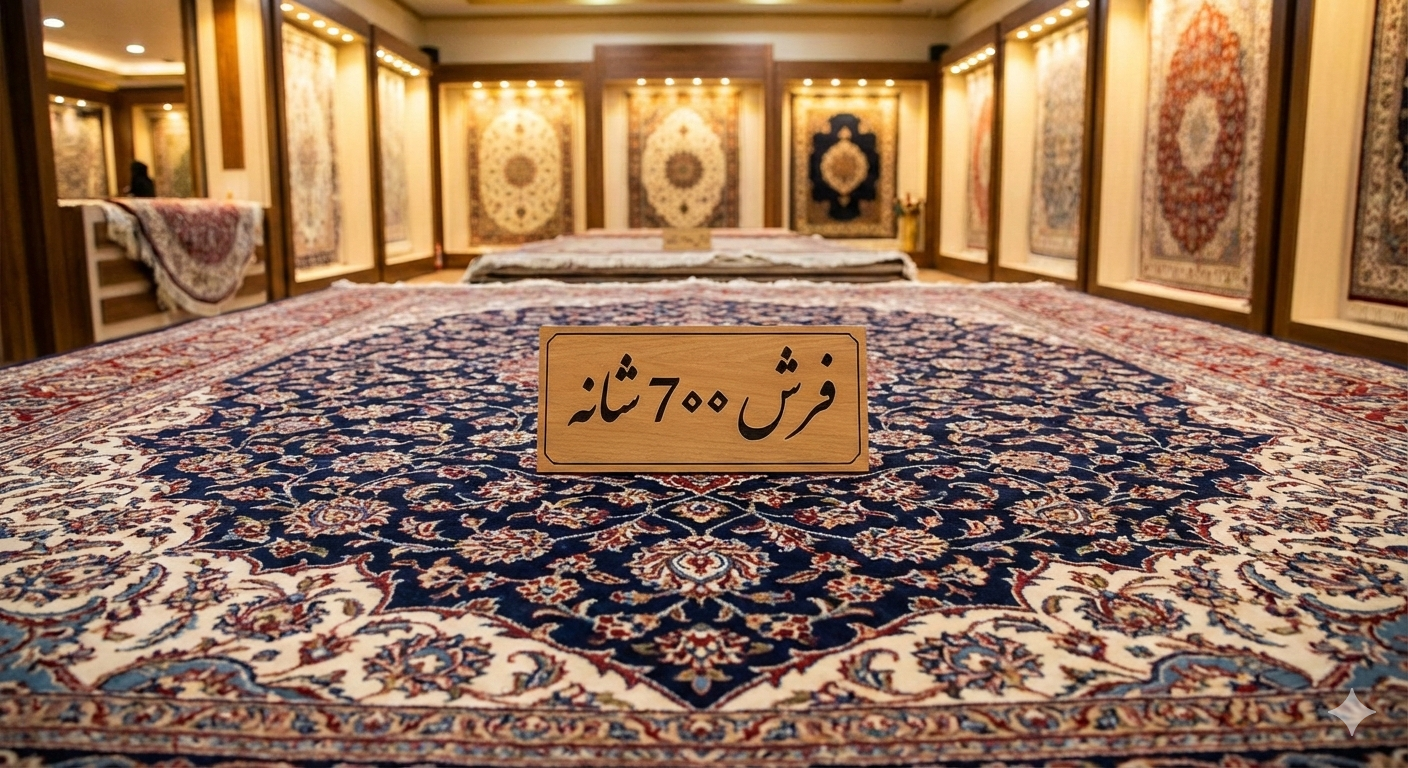
| 700 reed | Upper mid-range | Reception rooms, dining areas |
| 1000 reed | High-density | Formal rooms, fine designs |
| 1200 reed | Premium | Luxury interiors, detailed Persian patterns |
| 1440 reed and above | Ultra-premium | Showpiece carpets rivalling handmade quality |
When the reed count is combined with the pick or shot count along the length, the total knot density per square metre can be calculated. A 1200 reed carpet with 3600 shots, for example, contains over four million knots per square metre, a level of fineness that approaches that of a hand-knotted carpet.
4. Classification by Pile Type
Cut Pile
The most common construction, in which loops are sliced to produce upright tufts. Cut pile carpets have a soft, full appearance and are the basis of Saxony, plush, and velvet styles.
Loop Pile
Pile yarns remain in uncut loops. Loop pile is exceptionally durable and is the basis of Berber-style and many commercial carpets.
Cut-and-Loop
A hybrid construction that combines cut and looped areas to create sculpted, textured patterns within a single carpet.
Frieze
A cut-pile carpet with tightly twisted yarns that produce a curly, casual surface. Frieze hides footprints and vacuum marks well.
Saxony
A dense, smooth cut pile that displays a refined, formal appearance. Best suited to low-traffic, elegant rooms.
Plush and Velvet
Very dense, soft cut piles that produce a luxurious feel underfoot and a uniform, light-reflective surface.
Shag
Long, loose pile creating a deliberately textured, relaxed look. Popular in modern and retro interiors.
Berber
A loop-pile style, traditionally with flecked colour, named after the textile traditions of North Africa.
Carved and Embossed
Carpets in which the pile is sheared to different heights to produce three-dimensional sculptural effects. Modern Van de Wiele machines can produce carved designs directly during weaving.
5. Classification by Design Style
Traditional Persian
Faithful reinterpretations of classic regional designs, including Tabriz medallions, Kashan central-medallion floral patterns, Isfahan arabesques, Qom silk-style fine designs, Nain delicate palettes, and Kerman botanical motifs. These remain the heart of the Iranian machine-made carpet industry.
Modern and Contemporary
Abstract, geometric, minimalist, and artistic designs created for modern interiors. They use bold colour blocking, painterly textures, and unconventional compositions.
Vintage and Distressed
Carpets designed to evoke aged, faded, antique rugs, often with intentionally muted colour palettes and softened patterns. Highly fashionable in contemporary interior design.
Kilim and Tribal
Machine-made reinterpretations of flat-woven kilim and tribal patterns, capturing the geometric clarity of nomadic weaving traditions.
Children’s Carpets
Bright, playful designs featuring animals, alphabets, vehicles, and storybook themes for nurseries and children’s rooms.
Three-Dimensional and Embossed Designs
Carpets that use carved pile heights and shaded weaving to create the illusion of depth and sculpture.
Religious and Prayer Carpets
Specifically designed for prayer, often featuring mihrab niches and traditional Islamic motifs.
6. Classification by Size and Application
Standard Iranian Sizes
The Iranian market has long-established standard carpet sizes, including 6 square metres (roughly 2 by 3 metres), 9 square metres (roughly 2.5 by 3.5 metres), 12 square metres (roughly 3 by 4 metres), and larger formats such as 18 and 24 square metres. These dimensions correspond to traditional Persian room sizes and remain the most popular formats today.
Runners
Long, narrow carpets for hallways, corridors, and staircases.
Wall-to-Wall Broadloom
Continuous carpet rolls used for full-room installation, common in offices, hotels, and modern apartments.
Area Rugs and Accent Rugs
Smaller pieces that define spaces, soften hard floors, and anchor furniture arrangements.
Prayer Rugs, Door Mats, and Specialty Pieces
Including the small, single-person prayer rug, decorative wall hangings, and specialty sizes for particular cultural and practical uses.
The Science of Heat-Set Yarn and Why Acrylic Matters
Heat-setting is one of the least visible but most important processes in the entire premium carpet supply chain. Although the average buyer of a carpet rarely thinks about it, the difference between a yarn that has been properly heat-set and one that has not is the difference between a carpet that remains bouncy, resilient, and beautiful for many years and one that flattens within months. Because Molavi Carpet uses 100% acrylic heat-set yarn in every carpet we produce, this stage of the process is fundamental to who we are.
What Heat-Setting Actually Does
When a synthetic carpet pile yarn is spun, it is twisted to give it strength and to produce the characteristic plied appearance of a finished tuft. Without further treatment, however, this twist is unstable. The yarn wants to untwist, and once installed in a finished carpet, the pile tufts can splay open, lose their definition, and develop the matted, tired appearance that lower-quality carpets exhibit after a few seasons of use. Heat-setting solves this problem permanently. By passing the twisted yarn through a precisely controlled environment of high-temperature steam or hot air, the polymer chains within the fibre relax and then reset, locking the twist in place. The yarn that emerges is bulkier, more resilient, more thermally stable, and more durable.
The Two Dominant Heat-Setting Technologies
As described earlier, two companies dominate the global heat-setting machinery market. Superba, based in France and now part of the Vandewiele Group, uses saturated steam in its TVP series machines and is the long-established leader in the field. Power-Heat-Set GmbH, based in Germany, uses hot air rather than steam in its competing systems. Both technologies are capable of producing excellent heat-set yarn when operated correctly, and both have been adopted by leading carpet yarn producers around the world, including the Iranian yarn suppliers that serve the premium machine-made carpet industry.
Why Acrylic Heat-Set Yarn Is the Premium Choice
Acrylic is exceptionally well suited to heat-setting. The polymer responds beautifully to controlled thermal treatment, allowing the yarn to retain its softness while gaining the structural memory that keeps the pile upright over time. Compared with polypropylene, heat-set acrylic offers a warmer, deeper, more wool-like hand and a richer light reflection. Compared with wool, heat-set acrylic is lighter in weight, easier to clean, free of the moth and pest vulnerabilities of natural fibres, and consistently colour-stable. For a premium Persian-design machine-made carpet, where the goal is to produce a piece that looks and feels close to a fine hand-woven rug while remaining practical for daily life, 100% acrylic heat-set yarn is widely regarded by Iranian and international manufacturers alike as the ideal material.
The difference between an ordinary carpet and a carpet that ages with grace lies almost entirely in the quality of its yarn and the precision of its heat-setting. We choose acrylic, and we choose it heat-set, because nothing else matches its combination of softness, durability, and visual depth.
Inside the Modern Manufacturing Process
Producing a high-quality machine-made carpet is a multi-stage process in which traditional craftsmanship is preserved at every step, even as the work is carried out at industrial speed.
- Design and digitisation. Designers create the pattern in specialised carpet CAD software, defining colours, density, and any carving or texturing effects. The file is then translated into instructions for the loom and its Jacquard.
- Yarn selection and dyeing. At Molavi, only 100% acrylic yarn is selected, dyed to precise shades, and conditioned for the next stage.
- Heat-setting. The dyed acrylic yarn is passed through a continuous heat-setting line (such as Superba or Power-Heat-Set) where its twist is permanently locked and its bulk is developed.
- Warping. Thousands of foundation threads are wound onto large beams and prepared for the loom.
- Drawing-in and tying. Each warp thread is drawn through the heddles and the Jacquard, often using automated drawing-in machines such as the Stäubli SAFIR, and tied to the previous warp where appropriate using machines such as the Stäubli MAGMA.
- Weaving. The carpet is woven on a face-to-face Wilton loom (in our case, a Van de Wiele machine) producing two carpets simultaneously that are then separated by an internal blade.
- Backing. A latex coating is applied to lock the pile yarns in place, followed by a secondary backing for dimensional stability.
- Shearing and finishing. The pile surface is precision-sheared to produce a uniform height and a clean, velvet-like appearance.
- Edge binding and serging. Edges are bound, fringed, or serged according to the design.
- Quality control. Each carpet is inspected for weaving defects, colour accuracy, and dimensional precision before being rolled, labelled, and dispatched.
Molavi Carpet: Where Heritage Meets Precision
Molavi Carpet was founded on a simple conviction: that Iran’s ancient carpet heritage and the world’s most advanced weaving technology belong together. Every carpet that leaves our facility is woven on Van de Wiele machinery, the same equipment used by the most respected mills in Belgium, Germany, and Turkey, and woven from 100% acrylic heat-set yarn, the material we believe offers the finest possible combination of softness, durability, and visual richness for a premium Persian-design carpet. By committing exclusively to face-to-face Wilton weaving and to a single, carefully chosen pile fibre, we ensure that our products are dense, durable, and faithful in pattern to even the most demanding traditional Persian designs.
Our design studio works in continuous dialogue with both heritage and the present. We produce classical reinterpretations of the great regional schools, from Tabriz medallions to Kashan florals and Qom-inspired fine designs, and we also collaborate with contemporary designers on modern, vintage, and abstract collections suited to today’s international interiors. Every pattern is developed with the technical capabilities of our Van de Wiele looms in mind, and with the specific characteristics of 100% acrylic heat-set yarn in mind, allowing us to weave carpets at densities and resolutions, and with a hand and lustre, that earlier generations of machine-made carpets simply could not achieve.
We choose our acrylic yarn with the same attention. We work only with established suppliers whose heat-setting is performed on top-tier Superba or Power-Heat-Set lines, and we conduct extensive in-house testing for colour fastness, abrasion resistance, and tactile quality. The result is a carpet that not only looks beautiful on the day it is unrolled, but ages with grace, retaining its colour and feel through years of family life.
At Molavi Carpet we believe that a carpet is more than a floor covering. It is the quiet centre of a room, the surface on which life is lived, and the inheritance that one generation passes to the next. Our task is to make that inheritance worthy of the homes that receive it.
A Molavi carpet is woven where tradition refuses to fade and technology refuses to stand still: a Persian design, in 100% acrylic heat-set yarn, on the world’s most refined Van de Wiele looms.
Why Machine-Made Carpets Matter Today
In an era when handmade rugs of high quality are both rare and extraordinarily expensive, machine-made carpets perform an irreplaceable role. They put the visual richness of Persian and global design traditions within reach of ordinary households, offer levels of stain and abrasion resistance that handmade rugs cannot match, and can be produced in sizes and quantities suited to modern interiors.
A premium machine-made carpet, woven at high density on a Van de Wiele loom from 100% acrylic heat-set yarn, occupies a special middle ground. It is consistent and predictable in quality, accessible in price relative to a fine handmade piece, durable enough for daily family life, and yet capable of carrying patterns that would once have taken a master weaver years to complete. It is no exaggeration to say that the machine-made carpet has democratised the great Persian design tradition.
In addition, modern machine-made carpets offer environmental and practical advantages. Acrylic and other synthetic pile fibres are increasingly produced with improvements in energy efficiency and waste reduction. Wash-friendly synthetic carpets allow easy cleaning and contribute to healthier indoor environments. Computer-controlled weaving minimises waste of yarn and energy compared to earlier industrial methods.
Care, Longevity, and Maintenance
With proper care, a high-quality machine-made carpet woven from heat-set acrylic can last for decades. A few simple practices make a significant difference.
- Vacuum regularly. Weekly vacuuming removes the grit that grinds against pile fibres and slowly wears them down. For dense Wilton carpets, use a vacuum with adjustable suction to avoid pulling the pile.
- Address spills immediately. Blot, never rub. Acrylic carpets release most water-based stains readily if treated promptly.
- Rotate periodically. Turning the carpet by 180 degrees once or twice a year evens out wear from foot traffic and exposure to sunlight.
- Protect from direct sunlight. All carpets, however well dyed, eventually fade if exposed to strong direct sun day after day.
- Use rug pads. A good underlay protects the foundation, improves underfoot comfort, and keeps the carpet from sliding.
- Schedule professional cleaning. Deep cleaning every one to two years restores the brightness of the pile and extends the carpet’s life.
The Future of Machine-Made Carpets
The next chapter of machine-made carpet history is already being written. Designers are experimenting with artificial-intelligence-assisted pattern generation, allowing wholly new aesthetic languages to emerge while remaining rooted in regional traditions. Manufacturers are investing in recycled and bio-based fibres that reduce the environmental footprint of carpet production. The leading machine builders, particularly the Vandewiele Group and Stäubli, continue to push the boundaries of what looms can do, with finer resolution, more colour frames, greater speed, and increasingly elaborate three-dimensional effects.
At the same time, the cultural appetite for carpets that feel rooted, hand-crafted, and meaningful has never been stronger. The machine-made carpet of the coming decade will need to satisfy both impulses: technological excellence on the one hand, and a deep, palpable connection to heritage on the other. This is the territory Molavi Carpet has chosen as its home.
Conclusion
The history of the machine-made carpet is, in the end, a story about how human beings have continually re-imagined one of their oldest crafts. From the ancient looms of Persia to the steam-driven mills of nineteenth-century England and America, from the punched cards of Jacquard to the digital files of the modern Van de Wiele machine, every generation has added a chapter to the story of woven floor coverings. At each step, the goal has been the same: to bring beauty, warmth, and meaning into more homes, more reliably, and at higher quality than ever before.
Behind the modern machine-made carpet stands an extraordinary global industry of engineering companies: Van de Wiele in Belgium and the entire Vandewiele Group it now leads; Stäubli in Switzerland and Germany and the Schönherr legacy it inherited; Bonas in the United Kingdom; Superba in France and Power-Heat-Set in Germany; Card-Monroe Corp, Tuftco, and Cobble in the American and British tufting industry; and a wider supporting cast of spinning, dyeing, finishing, and inspection specialists. These companies, between them, have made it possible for a mill such as Molavi Carpet to translate the ancient design language of Persia into a product worthy of the homes of the twenty-first century.
At Molavi Carpet, we are honoured to take our place in that long tradition. We weave on Van de Wiele looms because they represent the very best of what carpet engineering can offer. We work in 100% acrylic heat-set yarn because we believe it is the material that best balances softness, durability, and visual richness for a premium Persian-design carpet. We design in the spirit of Iran’s centuries-old design heritage because we believe that heritage is the soul of any carpet worthy of the name. And we make every carpet with the conviction that, generations from now, it should still be a thing of beauty in the home that received it.
Whether you are choosing your first carpet, refurbishing a beloved home, or specifying floor coverings for a hotel or institution, we invite you to explore the Molavi Carpet collection and to experience the meeting of tradition and technology that defines our work.